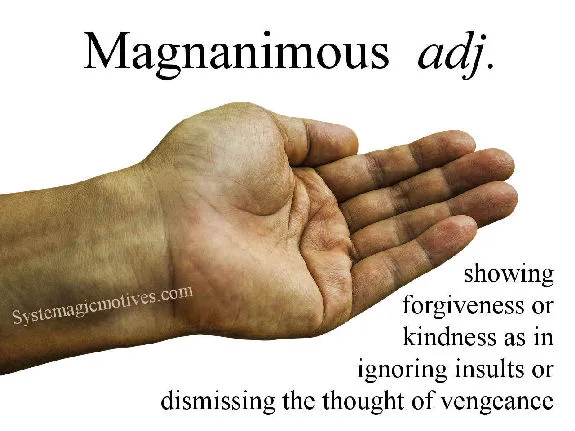
Magnanimous adj. Showing forgiveness or kindness as in ignoring insults or dismissing the thought of vengeance.
Magnanimity n. Generousness of spirit.
The term "magnanimous" describes a quality of being generous and forgiving, especially toward someone who might not necessarily deserve it. Originating from the Latin words "magnus" (great) and "animus" (soul or spirit), the term essentially means having a great soul. A magnanimous person displays an elevated sense of nobility and selflessness, often showing kindness and understanding even when it is not required or expected.
Magnanimity is often associated with notable figures who exhibit remarkable grace under pressure, such as leaders who forgive their adversaries or individuals who go out of their way to help others without seeking personal gain. This quality is seen as a mark of moral and emotional strength, as it involves transcending personal grievances and acting out of compassion and broad-mindedness.
In literature and history, magnanimous characters are frequently portrayed as heroes or saints, whose actions and decisions are driven by a higher sense of duty and humanity. Their stories often highlight the transformative power of forgiveness and generosity, inspiring others to adopt similar virtues. Magnanimity, therefore, not only enriches the lives of those who receive it but also enhances the character and reputation of those who practice it.
In behavioural psychology experiments, people who perform a magnanimous act—such as forgiving a slight or giving help without expecting anything in return—show a measurable drop in physiological stress markers within minutes. In other words, choosing the larger‑spirited path doesn’t just feel noble; it produces a real, observable calming effect in the body
"The weak can never forgive. Forgiveness is the attribute of the strong."
- Mahatma Gandhi
A magnanimous
heart forgives with gentle grace -
making peace blossom.