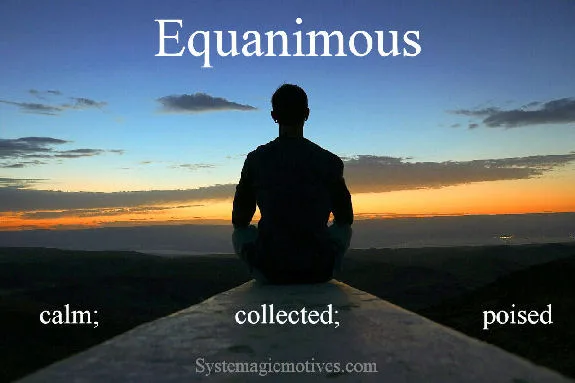
Equanimous adj. Calm; collected; poised.
n. Equanimity / Equanimousness
The term "equanimous" describes a state of mental calmness and composure, especially in difficult situations. Derived from the Latin word "aequanimitas," meaning "even-mindedness," it signifies an ability to maintain inner balance and tranquility regardless of external circumstances. When someone is equanimous, they exhibit a steady and composed demeanor, handling stress or adversity without losing their sense of equilibrium.
In practical terms, an equanimous person remains calm and collected even in the face of challenges or conflicts. This quality is valuable in high-pressure environments where maintaining a level-headed approach is crucial for effective decision-making and interpersonal interactions. An equanimous mindset helps in managing stress and navigating difficult situations with grace and stability.
Overall, "equanimous" emphasizes the importance of maintaining mental poise and emotional balance. It reflects the ability to remain unperturbed by external fluctuations, contributing to a sense of inner peace and resilience. This quality is beneficial for achieving clarity and composure in both personal and professional contexts.
"Even a happy life cannot be without a measure of darkness,
and the word happy would lose its meaning if it were not balanced by sadness.
It is far better to take things as they come along
with patience and equanimity."
- Carl Jung
In neuroscience, people who practice regular mindfulness show equanimous activity in the amygdala, the brain's threat detector. Instead of spiking under stress, their responses stay level, demonstrating that emotional equanimity can literally be measured in the brain.
Calm amidst chaos,
equanimous and still,
inner peace prevails.