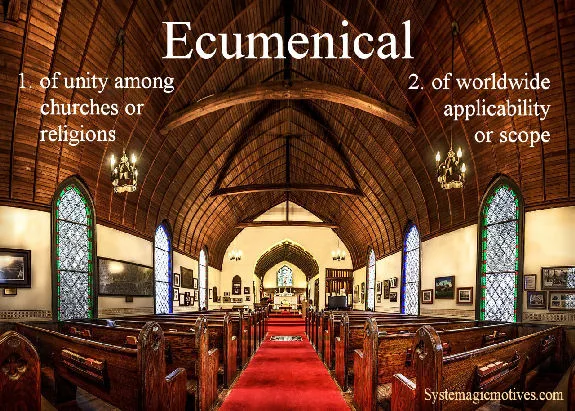
Ecumenical adj. 1. Of unity among churches or religions.
2. Of worldwide applicability or scope.
Olde: Oecumenical.
The word ecumenical comes from the Greek oikoumene, meaning "the whole inhabited world." It originally referred to the idea of universal unity, especially within the context of the Christian church, emphasizing a broad, inclusive approach to faith. Over time, ecumenical has expanded beyond religious connotations to refer to efforts or initiatives aimed at promoting unity, cooperation, or understanding across different groups, beliefs, or disciplines.
Today, ecumenical is used to describe movements, dialogue, or actions that seek to bring people or organizations together, whether in religious, cultural, or social contexts. It conveys an open, inclusive attitude toward collaboration and mutual respect, regardless of differences.
"An ecumenical perspective is one that seeks the widest possible view, drawing together voices that would otherwise remain apart."
- Vanity Fair, 27 Mar. 2026, describing cross-community collaboration efforts
Modern organizations sometimes use "oecumenical" in a strictly secular sense to describe collaborative efforts that span multiple institutions or disciplines, not just religions. For example, large humanitarian coalitions and academic consortia occasionally label their joint initiatives "oecumenical" to signal wide, cross-boundary participation rather than any specific creed. This usage reflects the term's broader sense of "general" or "worldwide in scope."
Ecumenical,
Bridges built from hearts and hands,
Uniting us all.