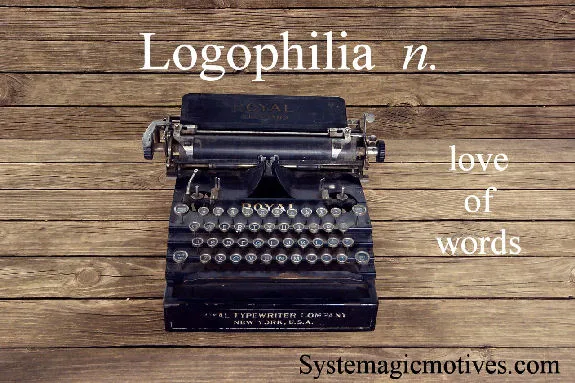
Logophilia n. Love of words and language.
Logophile n. One who loves words.
Etymologically, logophilia joins two Greek elements: logos (word, account, reason, discourse) and philia (fondness, friendship, love). Taken together, the term names an affectionate orientation toward language itself - a sustained attraction to how words carry meaning across minds. This is why logophilia often overlaps with rhetoric, literature, lexicography, and language learning: each field depends on choosing the right word at the right moment.
Logophilia is the love of words: not only their meanings, but their texture, cadence, and precision. A logophile is often drawn to language the way a musician is drawn to tone - listening for nuance, rhythm, and exact fit. In everyday life, this can show up as delight in unusual vocabulary, careful phrasing, puns, etymologies, and the subtle differences between near-synonyms. It is both playful and practical: playful because words are a source of joy, and practical because better words can produce clearer thought.
Reading studies show that frequent contact with varied vocabulary improves both comprehension and emotional granularity over time.
"Words are, of course, the most powerful drug used by mankind."
- Rudyard Kipling
logophilia
shapes a thought to stand upright-
words flow into place