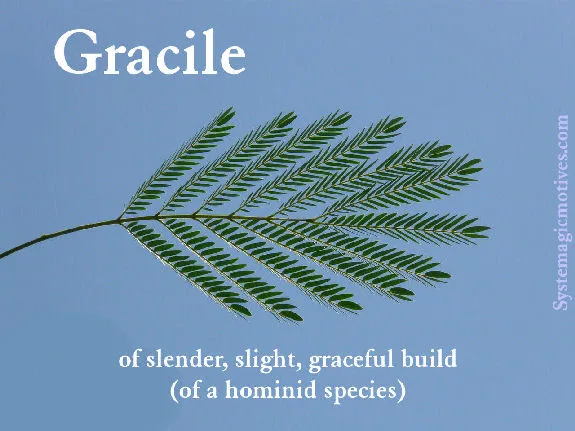
Gracile adj. Slender, graceful, and delicately formed.
The word gracile is derived from the Latin gracilis, meaning "slender" or "elegant." It is used to describe something that is thin, delicate, and graceful in appearance, often with an emphasis on its elegance or refinement. In biology, gracile is used to refer to organisms or body parts that are slender and lightly built, as opposed to more robust or stocky forms. For instance, a gracile species might have finer bones or a more delicate body structure. The term can also be used to describe certain anatomical features, such as a slender limb or a refined posture, that convey a sense of lightness and grace.
More broadly, gracile is often used to evoke a sense of beauty or fragility, suggesting a kind of natural elegance or purity. It might describe anything from a graceful dancer's form to the delicate branches of a tree swaying in the wind. The word carries a positive connotation, emphasizing the aesthetic quality of slenderness and the way it can make something appear effortlessly beautiful or fluid in movement. Gracile can therefore be applied to both living creatures and inanimate objects, always with a focus on the elegant and the subtle.
"Nothing is more beautiful than the loveliness of the woods before sunrise."
- George Washington Carver
In paleoanthropology, "gracile" and "robust" are formal body-form labels. A gracile skeleton has lighter bone structure and finer proportions, and these distinctions help researchers identify species and infer movement patterns from fossils.
Gracile lines in quiet frame,
move with poise and little strain.
Light in form yet sure in trace,
strength can travel wearing grace.
Gracile branches sway,
Soft whispers in the cool breeze,
Grace in every swerve.