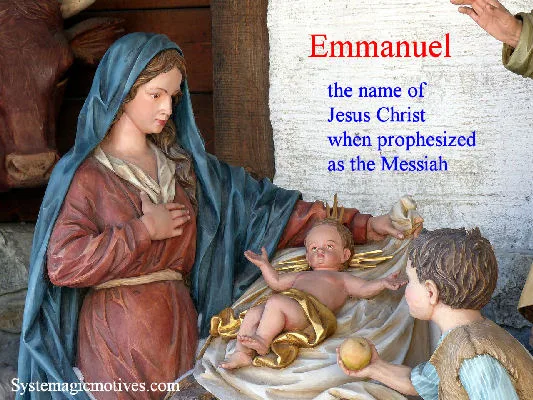
Emmanuel / Immanuel n. "God with us."
Emmanuel and Immanuel are two spellings of the same name, both meaning "God is with us." The difference in spelling comes from translation: Immanuel reflects the original Hebrew form (Immanu'el), while Emmanuel is the Greek and Latin rendering that carried into English and other European languages.
The name first appears in the Book of Isaiah (7:14), where it is given as a sign that God would protect the House of David. Later, in the Gospel of Matthew (1:22-23), the prophecy is interpreted as being fulfilled in the birth of Jesus Christ, making Emmanuel/Immanuel a central title in Christian theology. The word itself is built from two Hebrew roots: im (with) and El (God), forming the phrase "God is with us." Over time, the name spread widely across cultures, appearing in variations such as Manuel in Spanish and Portuguese.
In Christian tradition, Emmanuel is more than a name - it is a declaration of divine presence. During Advent and Christmas, hymns like O Come, O Come, Emmanuel emphasize the hope and comfort that God is not distant but intimately involved in human life. In Jewish tradition, however, the name is seen more as a symbolic sign rather than a messianic prophecy. Thus, Emmanuel/Immanuel bridges linguistic, cultural, and theological contexts, carrying profound meaning across centuries.
"Behold, a virgin shall conceive, and bear a son, and shall call his name Emmanuel."
- Matthew 1:23 (KJV)
...Immanuel is one of the earliest recorded examples of a theophoric name, where a divine element is embedded directly into a person's name. Ancient cultures used theophoric names as a way of expressing identity, protection, or belonging - making Immanuel part of a global pattern of names that carried meaning far beyond simple labels.
Emmanuel, in winter's longest night,
a name that turns the distant heart to light.
Not grace beyond all human view,
but presence walking with us too.