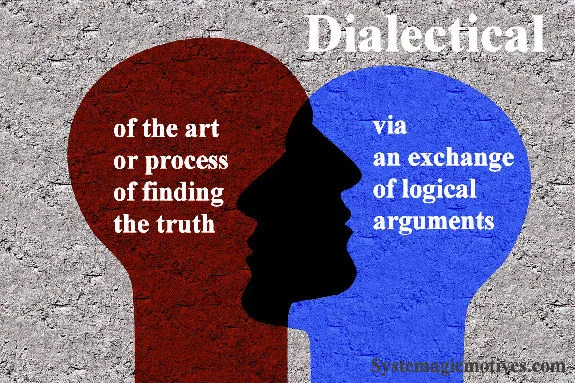
Dialectical adj. Involving reasoned dialogue between differing positions.
The term "dialectical" derives from the Greek word "dialektikos," relating to the art of debate or discourse. In essence, it refers to a method of argument that involves engaging with contradictions to reach a higher understanding. This approach is central to dialectical reasoning, a process in which opposing ideas are explored and reconciled through structured dialogue.
In philosophy, especially in the works of Hegel and Marx, the dialectical method is foundational. Hegel's dialectic involves the triadic structure of thesis, antithesis, and synthesis, where a proposition (thesis) is opposed by its contradiction (antithesis), leading to a resolution (synthesis) that transcends the original conflict. Marx adapted this method to analyze historical and social changes, focusing on class struggles and contradictions as driving forces of societal evolution.
Beyond philosophy, "dialectical" extends to fields like psychology and communication. In dialectical behavior therapy (DBT), for example, it describes a therapeutic approach that balances acceptance and change, helping individuals manage and resolve conflicting emotions. In communication, dialectical principles aid in addressing and reconciling opposing viewpoints, highlighting the importance of dialogue in resolving conflicts and achieving mutual understanding.
Researchers at the University of Queensland found that people trained in dialectical reasoning-the ability to hold two opposing ideas at once-show greater emotional resilience during conflict, because the brain's anterior cingulate cortex becomes less reactive when encountering contradiction. In other words, the more dialectical your thinking, the less your brain panics when reality refuses to be simple.
"The test of a first-rate intelligence is the ability to hold two opposed ideas in mind at the same time and still retain the ability to function."
- F. Scott Fitzgerald
Dialectical paths can turn,
through question, contrast, test, and learn.
When difference meets a listening mind,
a wiser middle will be alligned.